
Meat Breeds
Terminal or meat breeds are known for their fast growth rates and larger mature size, and produce quality market lambs. Lamb carcasses are well muscled in shoulder, loin and leg with a lean fat cover. Ewes of meat breeds tend to have lower lambing percentage, with higher birth weights, which may cause lambing problems, especially in ewe lambs.
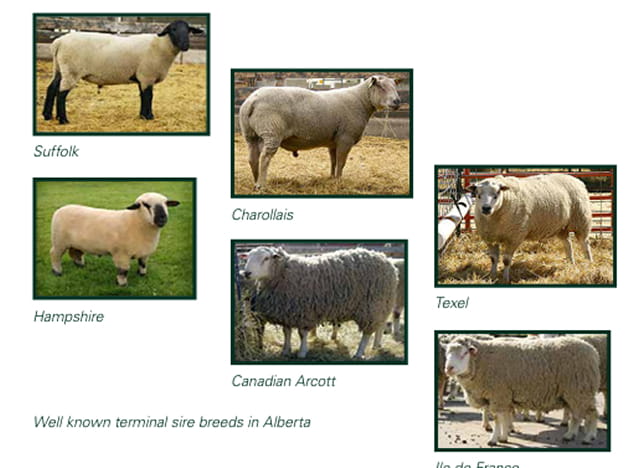
A terminal sire is one whose offspring are all marketed for slaughter. The Suffolk is the most common terminal sire in North America. Because all of the offspring are slaughtered, terminal sire breeds are selected primarily for growth and carcass traits.
Mothering traits such as less milk production and lamb bonding are not as strong in these ewes as in the maternal ewe breeds. Well known terminal sire breeds in Alberta are Suffolk (180% lamb production), Hampshire (160%), Canadian Arcott (180%), Charollais (175%), Texel (150%), and Ile de France (180%). Using a terminal sire produces better market lamb carcasses, resulting in the high quality food product consumers want. Retail stores and restaurants require consistent cuts of lamb with consistently low fat to keep Canadian lamb consumers coming back for more. Consumers expect consistent size and quality when they buy meat, especially premium meats like lamb.

Hair, Heritage, and Fine Wool Sheep
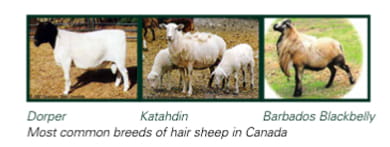
With the cost of shearing and the low return on wool, more breeds of hair sheep have been introduced into the country. Dorpers are a meat breed developed for dry areas. They have a mixture of hair and wool which drops off if not shorn. Ewes breed out of season, producing lambs (150%) that convert feed efficiently in intensive systems. The Katahdin is a medium sized, lean breed of meat sheep. They were first developed in Maine, USA. Katahdins shed their coat in the spring, and so require no shearing or tail-docking. Small at birth, lambs grow and mature rapidly to an acceptable market weight with good forage based management or with grain supplementation. The Dorper and the Katahdin are the two most common hair breeds in Canada. Often the two breeds are crossed. The Barbados Blackbelly is probably the third most common and the remaining three breeds, Wiltshire, Royal White, and St. Croix, are very uncommon. The disadvantage of these breeds is their slower growth rate, lower finish weight, and fat distribution on their carcasses.
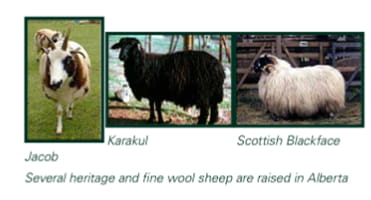
Several heritage and fine wool sheep are raised in Alberta. There is always a specialty market for heritage breeds for collectors of rare breeds such as Karakul, Jacob, Shetland, and Scottish Blackface. Jacob, Corriedale, Cotswold, and Icelandic. Fine wool is in demand with hand spinners, weavers, and crafters, who will pay a premium for their fleece.